It’s The Engagement
By Monica E. Oss, Chief Executive Officer, OPEN MINDS
April 9, 2026
Not surprisingly, consumers with an addictive disorder who are adherent to medication for opioid use disorder (MOUD) have lower costs of care. Those are the headline findings from a recent study—Association Between Extended-Release Buprenorphine Adherence & Reduced Healthcare Costs Among Insured Patients With Opioid Use Disorder.
Some of the other findings of the analysis have significant implications for designing and managing addiction treatment program models. Overall, only 24.7% of consumers (both from commercial health plans and Medicare) were adherent to the recommended treatment. Consumers who were adherent to a treatment program that included extended-release buprenorphine had the lowest total cost of care—total annual costs were $44,851 compared to $67,290 for those who were not adherent. Those consumers had lower inpatient utilization (5.5%), fewer emergency department visits (24.5%), and fewer detox episodes (4.9%).

In this study, all consumers had health benefits that included access to treatment and to medication for opioid use disorder (MOUD). The question then becomes what are the best practices and model designs that encourage adherence. That was a key theme in the recent webinar, Designing The OUD Cascade Of Care: What Works In Real-World Provider Settings, featuring Heidi Ginter, M.D., medical director at Acadia Healthcare. In the discussion, she emphasized two key points for executives designing addiction treatment programs: the right continuum model for addiction treatment is essential and sustained engagement of consumers with engagement requires a whole person, integrated care model.
As Dr. Ginter emphasized, the right continuum model is essential to sustaining engagement. The issue is not simply that consumers disengage. It is where and why that disengagement occurs and what that reveals about how treatment is designed. She noted that most addiction treatment programs are built around fixed levels of care, with the expectation that consumers will move through those levels in a predictable, stepwise progression. But models for treating opioid addiction do not follow a linear trajectory, and models built on that assumption create friction rather than continuity.
As my colleague Dr. Stuart Buttlaire, vice president of clinical excellence at OPEN MINDS, noted in framing the discussion with Dr. Ginter, “Across multiple studies and care settings, we continue to see steep drop-offs at every stage of treatment…fewer than half remain engaged beyond the first 90 days, and only a small fraction achieve sustained retention at one year.” He noted that those drop-offs are not random. They occur at predictable points in the care continuum. The highest-risk periods are concentrated in two windows: the first four weeks following treatment initiation and the first four weeks after discharge from structured care settings. And they are where both clinical risk and financial exposure are highest.
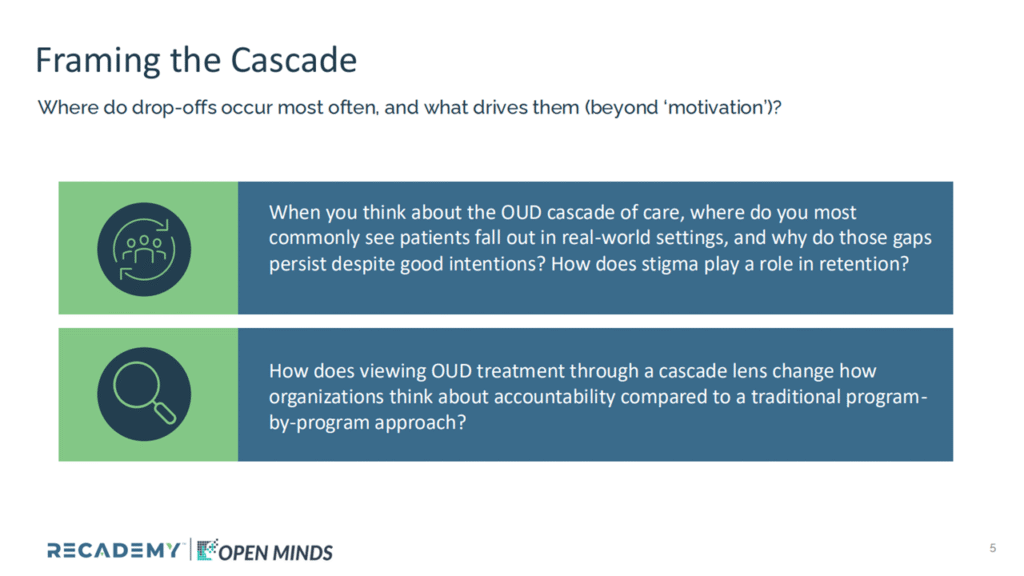
Dr. Ginter explained, “We see most people falling out of care in the first four weeks when they initiate care, or the initial four weeks after leaving a very structured form of care.” She continued by explaining that consumers do not move predictably through a fixed continuum. Their needs fluctuate and engagement varies. Many face co-occurring mental health conditions, unstable housing, transportation barriers, and other social determinants that disrupt continuity of care. When systems require consumers to conform to rigid pathways, disengagement is a predictable outcome. As a result, these consumers are more likely to drop out of recommended treatment models and incur more than 50% higher health care costs.
In addition to the right structure for a care continuum, sustained engagement for consumers with addictions also requires moving to a care model with that embraces a whole person, integrated care model. Dr. Ginter emphasized, engagement is not determined solely by medication or clinical intervention, but by whether consumers can navigate the broader set of challenges that affect their ability to remain in care. Co-occurring mental health conditions, housing instability, transportation barriers, and gaps in social support all contribute to disengagement when they are not addressed alongside treatment. Models that fail to integrate these factors into care delivery are structurally limited in their ability to sustain engagement over time.
Dr. Ginter described this misalignment directly: “If you checked these boxes…you would step down to this next level of care,” but in reality, “The steps that we put in front of them aren’t really matching how they want to walk.”
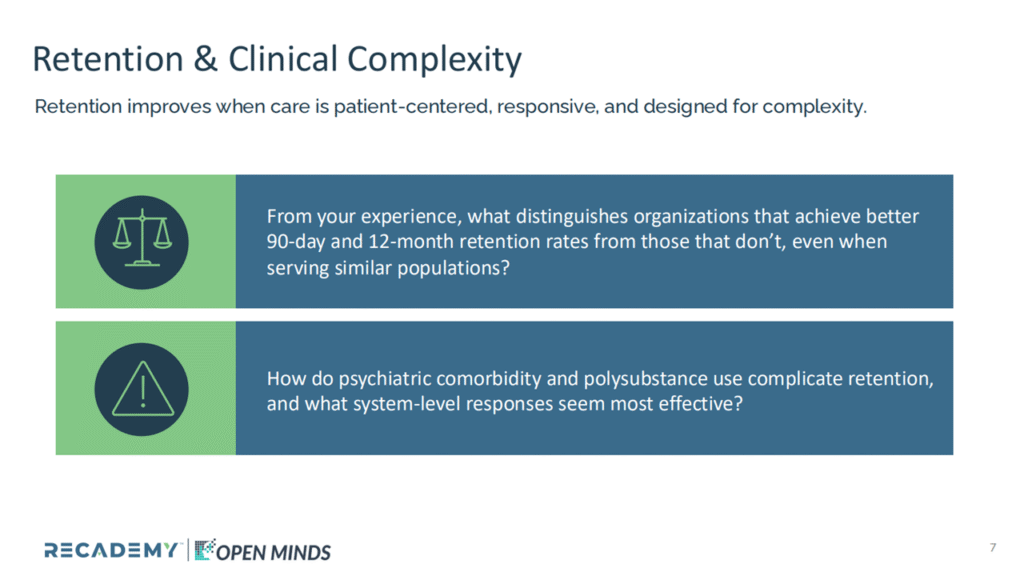
She emphasized that a whole person approach is most important at specific transition points in the treatment journey—discharge from residential programs, release from incarceration, and transitions between levels of care – because they are the least structured points in the continuum. Information is not consistently shared. Access barriers, including insurance coverage, transportation, and provider availability, are not resolved in real time. And she underscored that nowhere is this more visible than at discharge—the single highest-risk transition point in the treatment continuum.
In summarizing what provider organization managers should do to have the greatest impact on consumer adherence, Dr. Ginter was clear: “If you’re not offering MOUD at the time of discharge…you’re not doing the standard of care, and you’re putting the patients at risk.”
Want To Read More?
This content is exclusive to RECADEMY members.
RECADEMY is a comprehensive, research-based, online learning collaborative designed to provide critical information about emerging substance use disorder treatment topics and models of care.
Sign in or join the RECADEMY community for free today.