Accountable = Integrated
By Monica E. Oss, Chief Executive Officer, OPEN MINDS
October 11, 2025
Sixty-two percent of federally qualified health centers (FQHCs) are participating in some type of accountable care organization (ACO)—up from 44% in 2018. These were the findings of a new analysis—Advancing Accountable Care In Community Health Centers: Progress and Future Directions.
What was interesting is that participation in an ACO increased the FQHC adoption of key elements of whole person care models. For example, significantly more health centers in ACOs are notified when their patients visit the emergency department (68%) or are admitted to the hospital (70%) than health centers not participating in ACOs (53% and 55%, respectively).
More health centers in ACOs measure how many patients were screened, or screened positively, for unmet social needs (70%) than health centers not participating in ACOs (63%). More health centers in ACOs alerted consumers at point of care of needed services (85%, compared to others, 78%); reminded consumers of needed preventive services (68% versus 57%); and provided consumers with the option to refill prescriptions online (84% versus 69%).
This may be a function of financial incentives. More health centers participating in ACOs are eligible to receive financial incentives for achieving clinical care targets than the average—88% versus an average of 74%, respectively.
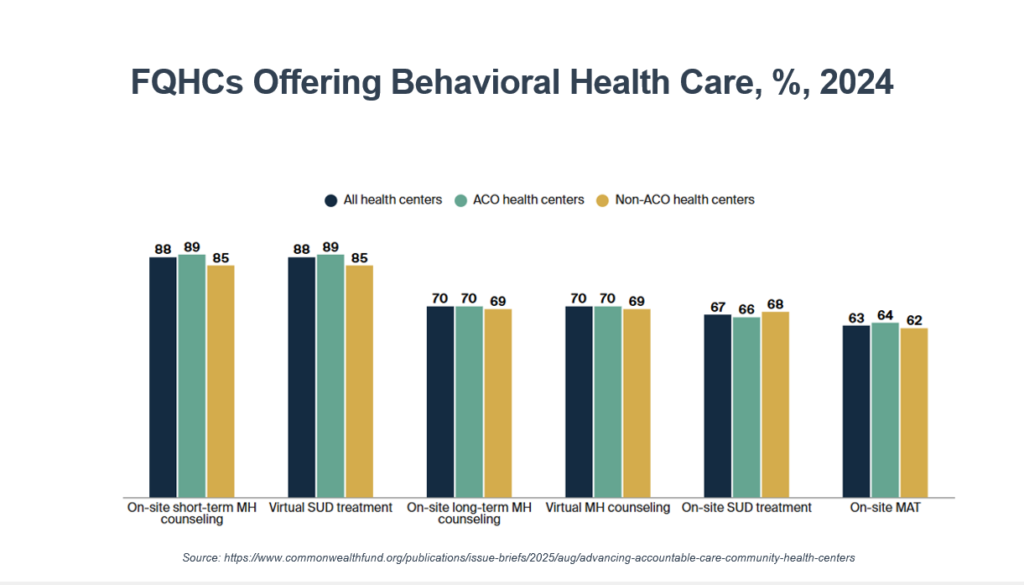
Interestingly, most FQHCs offer behavioral health services—89% provide short-term mental health counseling, and 70% offer long-term mental health counseling. In addition, 66% also offer on-site substance use disorder (SUD) treatment, and 64% offer on-site medication-assisted therapy for SUD. With regard to virtual services, 89% offer virtual SUD counseling services, and 70% offer virtual mental health counseling.
Rising health care costs, with an estimated increase of over 9% in 2026, will likely drive more payer and health plan interest in whole person care models and integrated care delivery systems—and the value-based reimbursement arrangements required to make them more effective.
Want To Read More?
This content is exclusive to RECADEMY members.
RECADEMY is a comprehensive, research-based, online learning collaborative designed to provide critical information about emerging substance use disorder treatment topics and models of care.
Sign in or join the RECADEMY community for free today.