How Stigma Stifles
By Monica E. Oss, Chief Executive Officer, OPEN MINDS
February 10, 2025
What are the key elements in helping consumers with addictions on the road to recovery? Medication is the “gold standard” for treatment —and therapy, a support system, self care routines, and a relapse prevention plan are all critical. But stigma about addictions and addiction treatment remains an impediment to successful treatment and recovery.
Despite the impact of stigma on treatment success, there are few evidence-based substance use disorder (SUD) stigma interventions. But recent research demonstrated some promising results of a new approach to stigma reduction: “enCompass: A Comprehensive Training On Navigating Addiction”. The enCompass intervention is an eight-hour, facilitator-led training that incorporates a range of stigma reduction techniques, including education on SUD, contact with individuals with lived experience, skill-building exercises, and discussions on non-stigmatizing language. Participants’ knowledge of SUD treatment and medication was assessed alongside their stigma levels.
Across all measured dimensions—stereotypes, prejudice, and discrimination—participants reported significantly lower levels of stigma after completing the training. Not only was there a decrease in stereotypes about individuals with SUD, but there was also a reduction in prejudice toward individuals with SUD. Additionally, there was a decline in discriminatory attitudes. Not surprisingly, individuals who had the least prior exposure to SUD information and/or had higher stigma levels saw the most significant improvements.
We had a chance to learn more about stigma and addictions in a recent OPEN MINDS Executive Roundtable, “A Culture Of Compassion: The Shatterproof National Stigma Initiative Case Study”, led by Senior Vice President of Shatterproof’s National Stigma Initiative, Courtney McKeon. Shatterproof is a non-profit advocacy organization based in Connecticut that is focused on improving addiction treatment and treatment access through consumer outreach, education to address stigma, and advocacy for policy changes.
The Shatterproof National Stigma Initiative is a campaign to reduce the stigma associated with substance use disorders (SUD) by raising awareness, educating the public and health care professionals, and advocating for policy changes to create a more compassionate environment. And Shatterproof is working with Anthem Blue Cross and Blue Shield Foundation to bring a curriculum on addiction for clinical professionals. The course is designed to help professionals better understand consumers and treat those consumers with less stigma.
Ms. McKeon spoke to the impact of stigma, defined as the accumulation of negative biases against people with substance use disorders, which negatively impacts their health, well-being, and quality of care. She said it is “a socially and culturally constructed process that reproduces inequalities and is perpetuated by the exercise of social, economic, and political power. The result is the creation of additional barriers for consumers who are seeking care, resulting in discrimination and exclusion.”
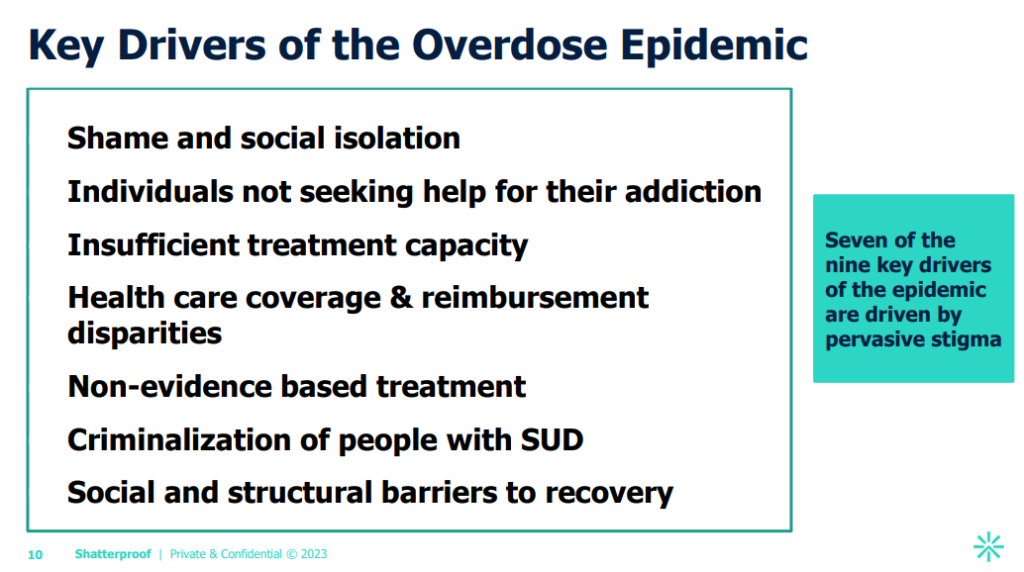
Ms. McKeon explained that seven out of the nine leading causes of the opioid crisis stem from stigma. These include feeling socially isolated, not getting help, not having enough treatment options, differences in insurance coverage, treatments not based on evidence, criminalizing people with substance use disorders, and social obstacles to recovery.
In 2021, Shatterproof launched its Shatterproof Addiction Stigma Index, a tool designed to assess levels of stigma using 50 validated stigma measures. The results of their research are striking. There are many misperceptions about the science—74% of Americans do not believe that a person with SUD is experiencing a chronic medical illness like diabetes, arthritis, or heart disease. And 55% don’t believe a person with SUD could be experiencing a mental illness, while 53% don’t believe a person with SUD could be experiencing a physical illness.
There are also personal biases against people an addiction. 49% won’t work closely with a person with SUD; 47% won’t maintain a friendship with a person with SUD; and 44% won’t socialize with a person with SUD.
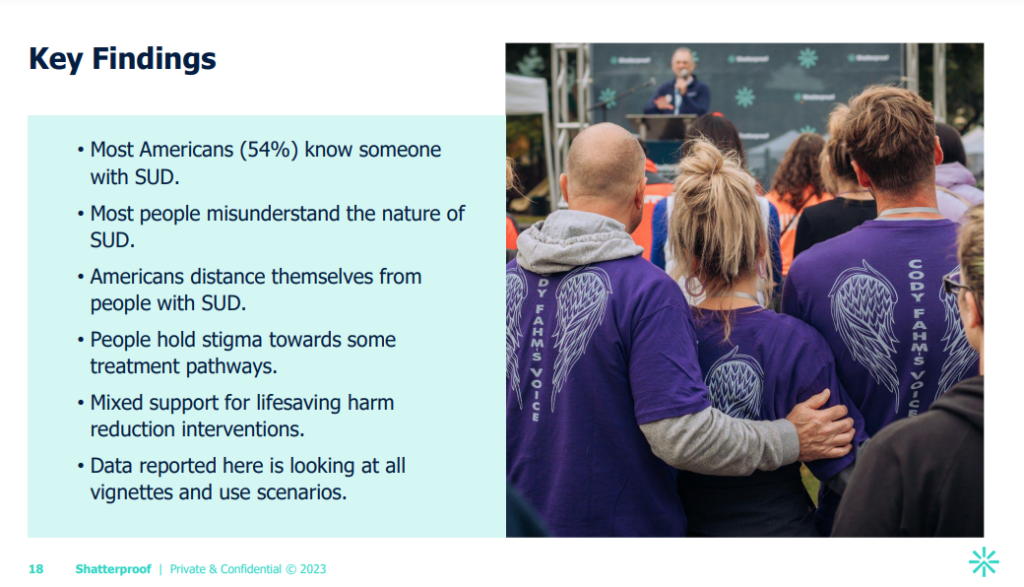
And on the treatment front, 43% believe that MAT is substituting one addictive drug for another. This leads to 47% reporting they aren’t willing to have an MAT clinic in their neighborhood. Most interesting is that the views of health care professionals were similar to those of the general population.
The challenges of health care professionals’ attitudes toward consumers with addiction and addition treatment is a concern for every executive team in the field. The total cost of care for consumers with an SUD is significantly higher than those without an SUD—according to one insurer, $5,200 in annual costs for members without a behavioral health and/or OUD condition—versus $20,000 in annual health care costs for a member with a behavioral and OUD condition. This difference decreases with treatment. And, 85% off consumers involved in the corrections system have an active SUD or are incarcerated for drug use or a crime involving drugs.
To address this, Ms. McKeon recommended that provider organization executive teams should assess and address for specific types of stigma toward SUD. First is the issue of public stigma—addressing negative attitudes among staff toward people with SUD. Provider organizations should also address self-stigma—when consumers accept societal stereotypes and experience reduced self-esteem. Executive teams should also look for structural stigma, system-level discrimination in organizational policies and practices. And, finally, provider organization executive teams need to assess the stigma against the use of MAT in treatment—largely fueled by the misconception that MAT is a form of addiction.
“Organizations really need to understand that it starts with leadership commitment,” said Ms. McKeon. “As leaders in the field, are you equipped and doing the things to serve as role models for the right behavior, policies, and culture? Leadership should model compassionate behavior and discuss stigma when appropriate.”
Want to Read more?
To view this content, please sign up or log in to your account.
Create an account in seconds or log in if you’re already a member.
Sign Up
Sign In