Finding ROI In MOUD
By Monica E. Oss, Chief Executive Officer, OPEN MINDS
May 12, 2026
The consumer outcome benefits of medication-assisted addiction treatment (MAT) for addictions are well documented, including higher remission (see Real-World Effectiveness Of Medication-Assisted Treatment And Psychotherapy For Opioid Use Disorder), increased odds of survival (see Evaluating The Optimal Duration Of Medication Treatment For Opioid Use Disorder), and fewer days of illicit opioid use (see Emergency Department–Initiated Buprenorphine For Opioid Use Disorder).
And the cost offset for these therapies is also well researched. A recent study—Association Between Extended-Release Buprenorphine Adherence And Reduced Healthcare Costs Among Insured Patients With Opioid Use Disorder—added to that research base. The study examined commercially insured and Medicare consumers with opioid use disorder who initiated extended-release buprenorphine (BUP-XR)—comparing consumers using medications for opioid use disorder (MOUD) in general and BUP-XR specifically to those not using MOUD.
Consumers not receiving MOUD had more than double the annual total cost of care compared to consumers adherent to BUP-XR ($67,290 versus $31,519 annually)—approximately 53% lower total cost of care among consumers adherent to BUP-XR.
For provider organizations and health plans, these findings highlight that the financial impact of OUD treatment is often driven less by medication expense alone and more by avoidable emergency department utilization, repeated inpatient admissions, detoxification episodes, and treatment disengagement among a relatively small but high-acuity population. Emergency department visits were highest for consumers not using MOUD—45.5% had an ED visit during the study year. ED utilization was lowest for consumers specifically adherent to BUP-XR (24.5%). Inpatient admissions excluding detoxification and detoxification program utilization were also highest among consumers not using MOUD.

The question for health plan and provider organization executives is how to realize similar improvements in clinical and financial outcomes using MOUD in their benefit plans and programs. That was the focus of a recent session, What’s Working In OUD Treatment & System Transformation: The ROI Of MOUD For Health Systems, Payers & Communities, with Charles Whitehill, M.D., chief of addiction medicine and recovery services for Kaiser Permanente’s Napa Solano service area, and my colleague OPEN MINDS vice president of clinical excellence and leadership, Stuart Buttlaire, Ph.D. They emphasized three essential ingredients in realizing an ROI from a program using MOUD—designing programs and workflows that acknowledge the complexity of the population, addressing the need for change management among clinical teams, and developing systems to track the total cost of consumer care.
The consumers with opioid addiction who benefit the most from MOUD are some of the most complex populations served in the health and human service system. Executives should identify the points in the care continuum where engagement and treatment adherence are most likely to break down—including ED discharge, psychiatric inpatient discharge, residential step-down, jail or prison release, and repeated outpatient treatment failure.
For these points of service, executive teams should rethink workflows and consumer engagement practices.
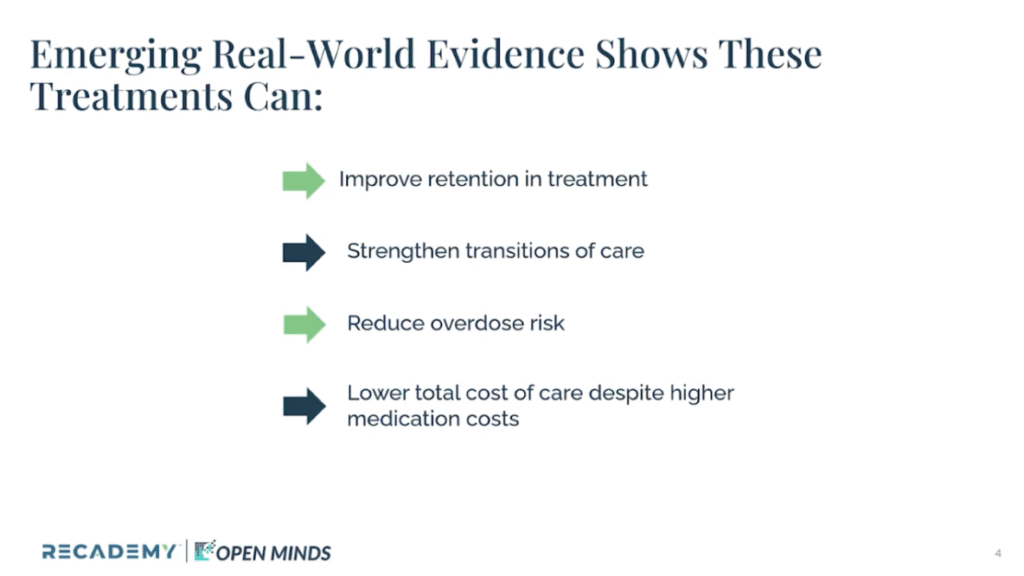
“In an outpatient setting with somebody who you may have tried multiple times to start and you’ve been unsuccessful with because it’s a very transient window of opportunity, this approach may be useful,” said Dr. Whitehill. “In the emergency department, there’s typically a very small window in which you see people, and you become familiar with the people who are extremely high risk. Maybe they’ve had multiple ED visits for overdose or substance use-related issues, and this would be somebody for whom a long-acting injectable would be particularly useful.”
But these changes in program design and workflows are often significant changes for clinical staff. Executives should treat the implementation of new service models using long-acting injectable medications for opioid use disorder (LAI MOUD) as a substantial change initiative. This requires training on a number of topics. One area is the program’s criteria for LAI MOUD use, defining appropriate, gray-area, and inappropriate use cases so the organization can demonstrate credibility. Training on new processes—including the administration of medications and referral and consultation pathways—is also helpful.
“This is where I think it’s important to partner with your addiction medicine providers and develop a protocol of who is appropriate to start on these long-acting injectables and maybe consider other situations that are considered gray areas,” said Dr. Whitehill. “In fact, [look at] other situations where this medication may not be appropriate to use.”
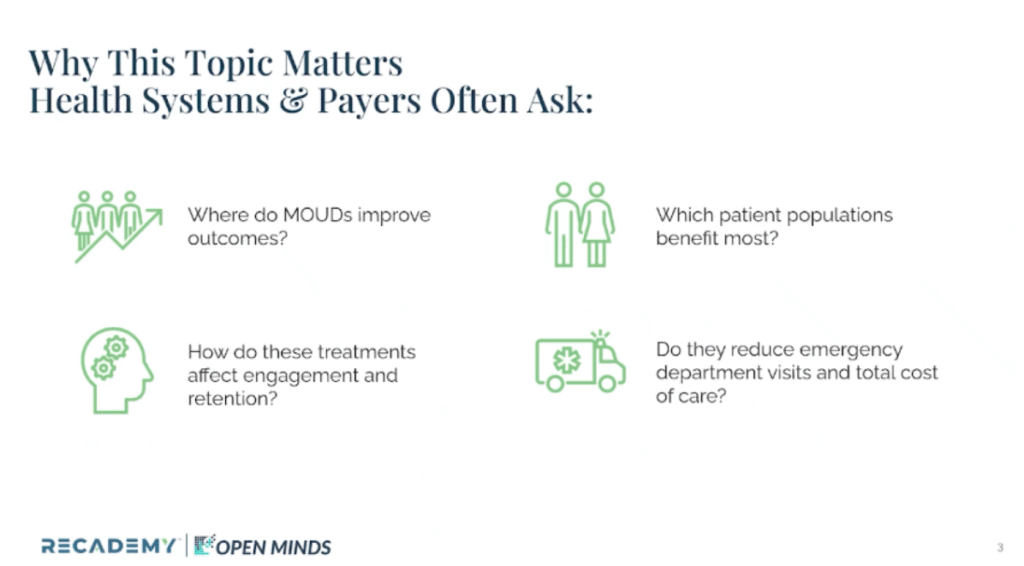
Finally, executives need measurement systems that track total cost of care—not simply pharmacy expense—including ED utilization, inpatient admissions, detoxification episodes, rehabilitation costs, and treatment retention. This data is important for two reasons. First, to demonstrate the value of the model to health plans and other payers. Second, to enable addiction treatment provider organizations to enter into more meaningful value-based contracts. The performance management framework should track the expenses of total ED use, all-cause inpatient utilization, rehabilitation program costs, and medication expense. Typically, while medication costs are significant, the cost savings are substantial.
“They’re typically $1,500 to $2,000 for a monthly dose, which really gets your attention,” said Dr. Whitehill. “But when appropriately used, these medications increase treatment adherence and reduce emergency department visits and hospitalizations. You have to think about the total cost of care.”
The speakers emphasized that the slow but steady increase in the use of MOUD in addiction treatment needs to be accompanied by an expanded view of its role in consumer health. As Dr. Buttlaire concluded, “The value of LAI MOUD depends not simply on medication availability, but on disciplined implementation, appropriate patient selection, clearly defined clinical criteria, and workflows designed to support sustained engagement.”
Want To Read More?
This content is exclusive to RECADEMY members.
RECADEMY is a comprehensive, research-based, online learning collaborative designed to provide critical information about emerging substance use disorder treatment topics and models of care.
Sign in or join the RECADEMY community for free today.